
We are in the middle of a heatwave right now. And if your social media is anything like mine, you will be seeing the same advice everywhere. “Freeze a kong”. While the filling suggestions may differ, recipe suggestions range from soaked kibble and wet dog food to more elaborate recipes featuring yoghurt, honey and fruit. The premise is the same. Stuff the Kong with the food, put it in the freezer, and when frozen solid, give it to your dog as a cooling activity.
I want to be clear: frozen kongs can absolutely be a fantastic form of enrichment. And so I’m not telling you to stop or throw yours away. I’m just asking you to take a moment to ask yourself:
“Is this actually the right activity for my dog?”
Consider the goal of enrichment……
When we provide our dogs with enrichment, the goal is often to offer them opportunities to engage in activities that provide mental, physical, and sensory stimulation and promote positive welfare and emotional well-being.
Food enrichment is just one part of the picture alongside things like opportunities for social interaction, exploration, problem-solving, play, physical activity and learning new skills.
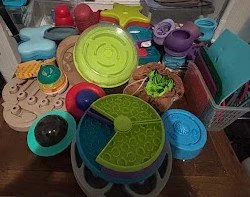
If you know me, you know I love a good activity feeder. Over the years I’ve accumulated quite a collection of puzzle feeders, snuffle mats, slow feeders, lick mats, movement toys, Toppls, Kongs... and I use them regularly with both my own dogs and many of my behaviour clients.
However, when choosing enrichment, while I might have a goal in mind, I don’t start with an activity; I start with the individual dog in front of me.
How I approach choosing the right food enrichment for dogs
The right enrichment depends on the individual. Every dog is different. Some love working for food and problem solving, others prefer licking, some are dexterous and like to manipulate toys, others prefer to sniff things out.
When introducing any activity feeder, we should think about:
What does this dog naturally enjoy?
Have they used activity feeders before?
Do they understand how to access the food?
Is this likely to be challenging in a rewarding way, or simply frustrating?
Like any skill, activity feeding has a learning curve.
We usually begin with the easiest versions before increasing the difficulty.
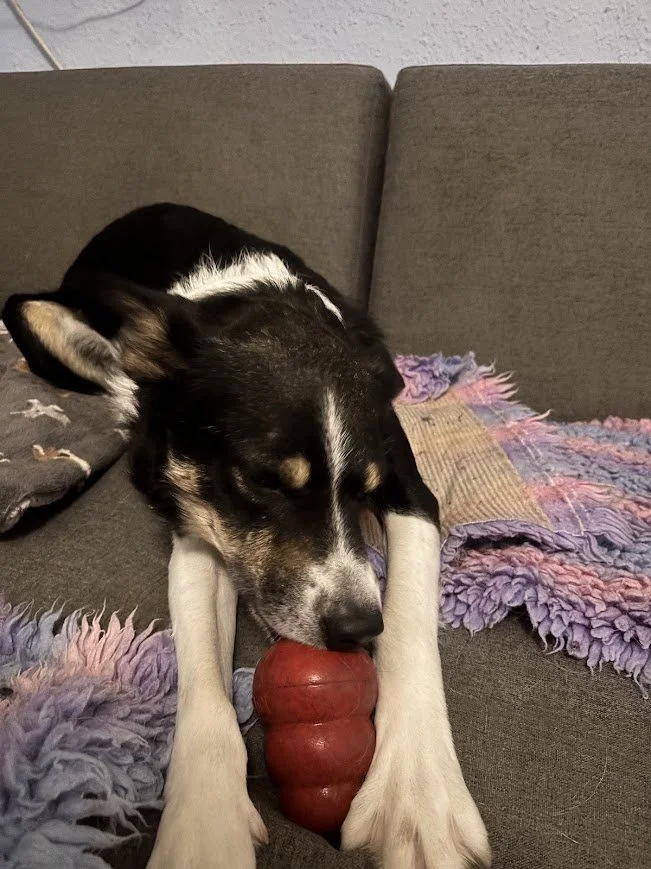
So what's my issue with frozen kongs?
It’s not the frozen kongs themselves, but that freezing a kong is one of the most difficult versions of the activity. The food is packed into the kong with only a small hole to access it through; dogs often have to work for a long time until the food begins to melt and they can access it. This means a lot of work before they receive reinforcement.
For many dogs, that can be really enjoyable and keep them busy for a long time, but for others, it can be incredibly frustrating.
Why is frustration a problem?
Frustration is a normal emotional response that occurs when access to something the dog wants is blocked or delayed. Frustration itself, in small amounts, isn’t harmful, and for animals in general, it serves to increase persistence and effort in an activity until they get the reward. But when there is too much frustration, it stops the activity from being enriching and promoting emotional wellbeing, and instead it becomes emotionally aversive.
Some dogs are naturally more prone to frustration than others.
This may include dogs who are:
naturally impulsive
highly food motivated
experiencing pain
already stressed or emotionally aroused
living with behavioural challenges that reduce their frustration tolerance
And some situations can make a dog prone to frustration, such as environmental conditions that reduce their overall tolerance - like now with the extreme heat we are experiencing.
For these dogs, a frozen Kong may not be a relaxing activity at all.
Instead, it may leave them increasingly worked up as they try to reach food they can't easily access.
This is something I’ve seen firsthand. Both with my own dogs and with those I worked with in rescue. In rescue, some dogs absolutely loved a frozen Kong, while others became visibly frustrated. And watching this made me reconsider my view of frozen enrichment as universally enriching and good.
Because the same activity I as a human thought would be positive produced completely different emotional experiences depending on the individual dog. So it’s not about the activity itself, but how the dog perceives it.
Other considerations when giving frozen enrichment
Resource guarding - Having a high-value item containing food that is difficult to access may increase its value to a dog. Some dogs may be more likely to guard a frozen kong, even if they don’t usually guard food. My own dog Jasper, who struggled with resource guarding, found frozen kongs frustrating rather than calming, and this meant they often increased his arousal rather than relaxing him, and he would become increasingly hypervigilant when he had one.
Dogs with dental sensitivity - The cold of a frozen kong may be painful to dogs that have damaged teeth or dental disease and experience dental sensitivity as a result. This may be more likely in older dogs.
Rather than asking “Are frozen kongs a good form of enrichment?”, it might be better to ask, “Is this the right enrichment for my dog, today?”
Questions to ask yourself:
Does my dog actually enjoy this activity?
Do they have the skills to succeed?
Is it likely to leave them calm, or increasingly frustrated?
Do they have any dental pain or sensitivity?
Are they likely to become very active and overheat while trying to access the food?
And the answers to this question may differ over time.
My oldest dog, Scamp, loved frozen Kongs when he was younger. But at nearly 16, they're simply too difficult for him now. Bilbo, on the other hand, becomes so active trying to solve movement-based feeders that I often avoid using them during very hot weather because he ends up making himself hotter.
So if the answer is “No, a frozen kong isn’t suitable for my dog right now” what is the alternative?
You could reduce the difficulty of the activity; this may look like:
Freezing food only partially or letting it defrost for a while before giving it to your dog
Pack the food less densely
Use chilled food rather than frozen food
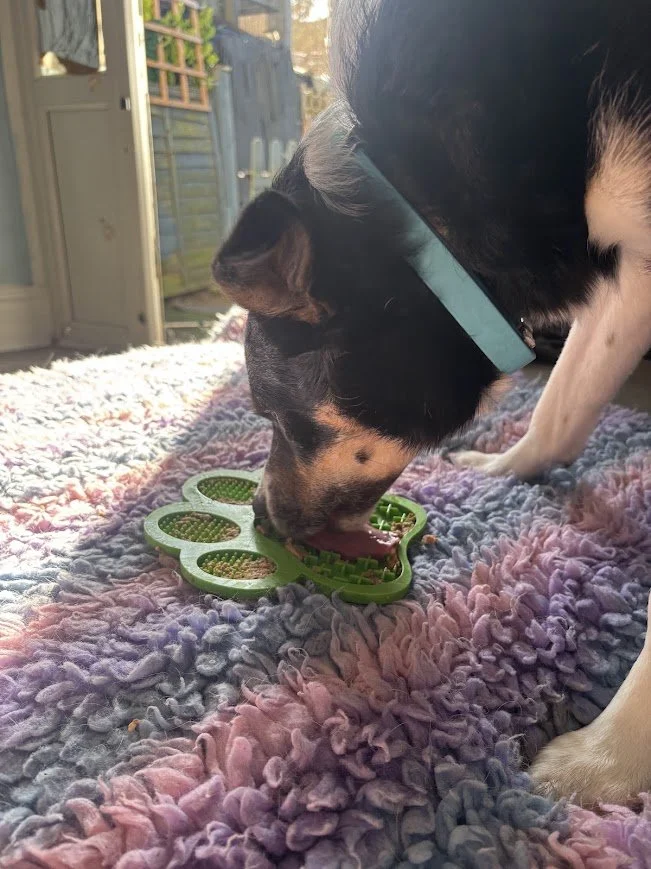
Choose open feeders like topples, freezebones or lickmats where the hole to access the food is bigger so some of the food is always accessible.
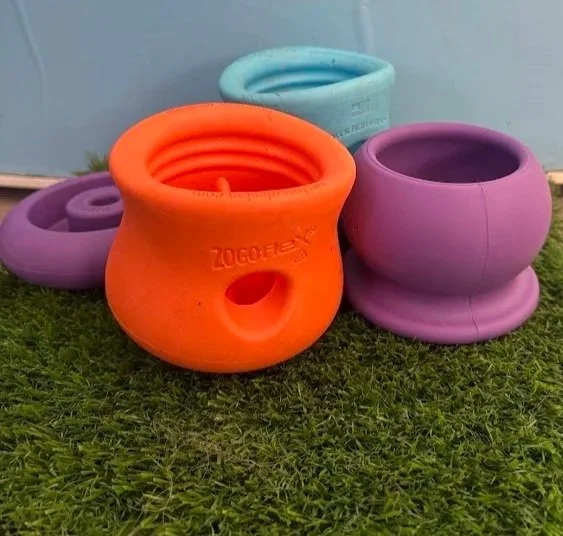
Example of some more open enrichment alternates
(freezebones and Toppls)
Watch out for signs of frustration including:
repeatedly pawing or throwing the toy
biting or chewing intensely rather than calmly licking
vocalising
pacing with the toy
repeatedly abandoning and returning to it
becoming increasingly tense or aroused
guarding the item
These may be signs that the activity is too difficult for your dog, or that it isn’t suitable at all.
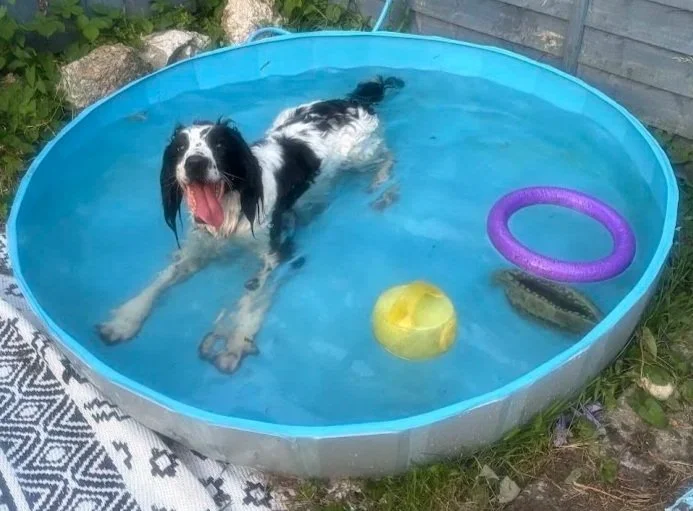
You could provide them with another cooling activity - This may look like:
giving them access to a paddling pool
getting them to bob for treats in a washing up bowl
adding cold water to their food bowl or giving them chilled water
The take-home message
Frozen kongs are neither good nor bad. Enrichment isn’t a one-approach-suits-all type of thing.
When choosing enrichment for your dog during the heatwave, use similar considerations you would for choosing enrichment activities any other time. Just because a form of enrichment is popular doesn’t mean it will automatically suit your dog.
The best enrichment is the enrichment that your dog enjoys, can succeed at, and leaves them feeling better rather than more frustrated.
